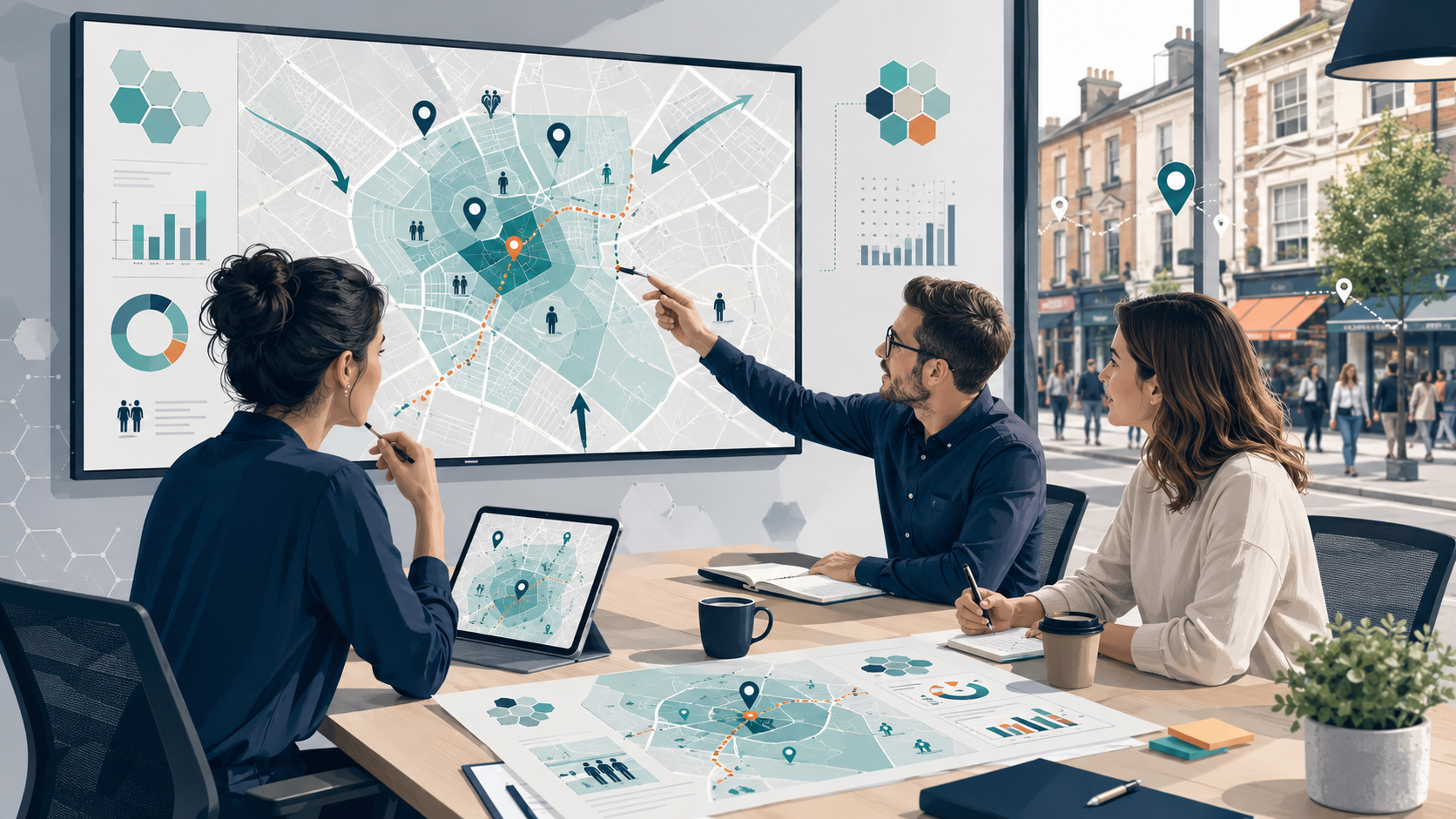
Location intelligence can help marketers make better decisions about where to focus their activity, who to target and how to make better use of their marketing budget.
By combining geographic data with information about customers, demographics, competitors, footfall and consumer behaviour, businesses can build a much clearer picture of the audiences and opportunities surrounding different locations.
This can help you identify where potential customers are, understand how different catchments behave and decide where marketing activity has the greatest potential to make an impact.
What is Location Intelligence marketing?
While understanding how location intelligence works is the first step, applying those insights to marketing means using location-based evidence to inform your targeting, campaign planning and investment decisions.
Location intelligence marketing brings together different types of data that have a geographic element. This might include customer locations, demographics, consumer characteristics, store performance, competitor locations and patterns of footfall or movement. Analysing this information geographically can reveal differences and relationships that aren’t always obvious from individual datasets.
For example, two areas may have similar population sizes but very different customer profiles. Two high streets might attract similar levels of footfall but draw visitors from completely different catchments.
Understanding those differences helps marketers decide where to focus rather than treating every location in the same way.
How can Location Intelligence improve marketing?
One of the biggest advantages of location intelligence is the ability to make marketing more targeted. Instead of spreading activity evenly across a large geographic area, you can identify locations with the strongest potential and concentrate your resources accordingly.
Location intelligence can help answer questions such as:
- Where are our highest-potential customers?
- Which areas contain more people who match our target audience?
- Where are we currently under-represented?
- Which locations should we prioritise for a campaign?
- Where are competitors particularly strong?
- Which areas are attracting the right type of footfall?
- How do audiences differ between our locations?
The answers can inform decisions across out-of-home advertising, direct mail, geographically targeted digital advertising, local campaigns, events and other marketing activity.
Finding new customers
Location intelligence can help identify areas where people with similar characteristics to your existing or target customers are concentrated.
Imagine a food retailer looking to attract more young professionals.
A customer intelligence tool can help the retailer understand the characteristics of its customers. Adding location data can then reveal where similar audiences are concentrated and how those areas relate to its existing store network. Rather than running the same campaign across every store or targeting an arbitrary radius around each location, the retailer could identify the areas with the strongest potential. It could then concentrate geographically targeted advertising, direct mail, out-of-home activity or local promotions in those areas.
This means the geography of the campaign is based on evidence about where the right audience is most likely to be found.
Understanding your existing customers
Location intelligence can also reveal more about the customers you already have.
By analysing customer data geographically, businesses can understand where customers come from, how catchments differ and where there may be opportunities to increase market penetration. A retailer might discover that two apparently similar stores attract very different types of customers. One may predominantly serve nearby residents, while another attracts commuters or visitors from a much wider area. These differences can influence the products, offers, messaging and marketing channels that are most appropriate for each location.
The same analysis can also identify areas containing people who closely resemble existing customers but where the business currently has relatively low customer penetration. These areas could represent valuable opportunities for acquisition activity.
Choosing where to invest your marketing budget
Location intelligence becomes particularly valuable when there are several apparently similar opportunities competing for marketing investment.
Imagine a business considering a local campaign across 12 high streets. Footfall alone might suggest that all 12 deserve investment. But when the business compares visitor profiles, movement patterns, customer penetration, competitor proximity and other location factors, significant differences may emerge. Some areas may offer considerably greater potential than others. Instead of dividing the budget equally, the business can concentrate activity where the evidence suggests it has the greatest opportunity to make an impact.
Understanding when and how people use a location
Where people live is only part of the picture.
Movement and footfall data can show how people use different places, including where visitors have travelled from and how activity changes by hour, day or season. This can be particularly useful for location-based marketing. A busy location isn’t automatically the right location for a campaign. What matters is whether the right people are there at the right time.
Understanding these patterns can help businesses make better decisions about where and when to run out-of-home advertising, local promotions and other geographically targeted activity.
Turning location data into better marketing decisions
The value of location intelligence for marketing isn’t simply having more data or seeing it displayed on a map. It’s being able to combine the right evidence to answer a specific marketing question.
That could be where to find more potential customers, which locations to prioritise, where competitors are strongest or where marketing investment is most likely to make a difference. Periscope® brings together location, demographic, customer, competitor and movement data, helping marketers compare locations, understand their audiences and make better-informed decisions about where to focus.
Discover how Periscope® can help you make more informed marketing decisions.